How to Organize Sewing Supplies: Thread, Notions and Needles
Sort a tangled sewing box into five families of notions, then give each the container that suits it: thread by color with bobbins beside the spools, zippers by length, buttons in jars, pins and needles in closed cases.
At a glance
What you need
- Five sorting trays or shoebox lids
- Magnetic dish
- Small zip bags and a marker
- Lidded pin box and a needle book or case
- Jars or a compartment box for buttons
- Small sealed container for used needles
Open the average sewing box and you find a thread tail wrapped around a zipper, loose pins at the bottom, three bobbins of unknown color and a card of buttons from a coat you no longer own. Everything is in there. Finding it is the difficulty.
The answer to how to organize sewing supplies is to stop treating them as one category. Notions fall into five families that are different shapes, are used at different moments and need different containers. Separate the families, give each a home near the machine, and the tangle has nowhere to form.
The five families of notions
- Thread and bobbins
- Pins and needles: straight pins, clips, hand needles, machine needles
- Fasteners: buttons, zippers, snaps, hooks and eyes
- Elastic and trims: elastic, bias tape, ribbon, lace, cord
- Marking and measuring tools: tape measures, gauges, chalk, marking pens, seam rippers

Fabric and cutting tools are not on the list because each needs its own system. See how to store fabric so every piece is visible, and for shears, rotary cutters and their spare blades, storing scissors and cutters closed and guarded.
Prepare, then sort in six steps
Gather these first:
- Five bowls, trays or shoebox lids, one per family
- A magnet or magnetic dish for picking up stray pins
- Small zip bags and a marker
- A small jar or tin with a lid, for worn and broken needles
- Whatever containers you already own: jars, tins, a cutlery tray, a compartment box
- Empty everything onto a clear table. Run the magnet across the bottom of the old box and over the table to collect loose pins first.
- Deal each item into one of the five trays. Do not sub-sort yet.
- Remove what is finished: empty spools, bent pins, stretched-out elastic, dried marking pens. Bent pins and broken needles go into the lidded jar.
- Take one tray at a time and divide it as described in the sections below.
- Choose a container for each group that holds it in a single layer where possible.
- Label each container and place it within reach of the machine or the hand-sewing chair.
Thread and bobbins
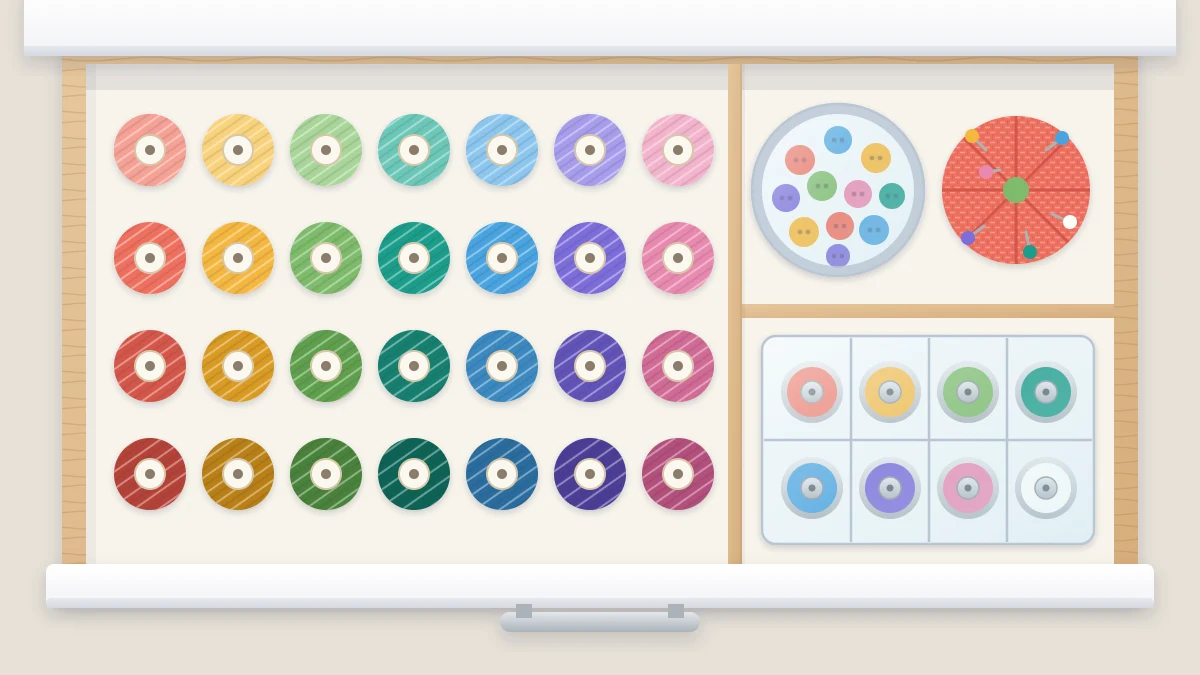
Thread is chosen by color, so every spool end should be visible at once. There are two good arrangements.
- A thread rack: spools sit on pegs, on the wall or standing on a table. It is quick to scan, but open to dust and light, so it suits thread you use regularly. Keep it out of direct sun.
- A shallow drawer or lidded box: spools stand upright, or lie in rows on their sides, in a single layer. A drawer about 3 in (8 cm) deep inside fits most standard spools standing. This protects the thread and holds more in less space.
Either way, arrange by color family, light to dark, with black, white, gray and beige together at one end since those are used most.
A wound bobbin belongs next to its spool. On a rack, slip the bobbin onto the same peg under the spool. In a drawer, stand it in front of the spool or join the two with a bobbin clip or a small elastic band. Empty bobbins go together in one small box.
Tuck every thread tail into the notch on the spool rim, or hold it with a small piece of low-tack tape.
Buttons, zippers and snaps
Buttons are sorted either by color in clear jars, which is fast and pleasant to look at, or by size and type in a compartment box, which is better when you need six that match. Whichever you choose, keep sets together: thread matching buttons onto a safety pin or a loop of thread, or bag them. The compartment-box method is the same one used for beads, described in sorting and storing beads and findings.
Zippers are chosen by length first, then color. Fold or loosely coil each one, secure it with a clip, and file them standing on edge in a shallow box in length order: short, medium, long, with separating and invisible zippers at one end.
Snaps, hooks and eyes stay on their cards where possible. Loose ones go into a compartment box, one size per section.
Pins and needles
These are the supplies that hurt when they stray, so each kind gets a closed or fixed home.
- Straight pins: a lidded pin box or a magnetic dish.
- Hand needles: a needle book with felt pages or a closed needle case, grouped by type. Never loose in a drawer or pushed into the arm of a chair.
- Machine needles: in their original cases, which state type and size. Keep the cases together in one small box.
- Used, bent or broken needles and pins: into the small sealed container. When it is full, dispose of it according to your local rules.
Safety note
Where children or pets are around, keep pins, needles, seam rippers and cutting tools in closed containers on a high shelf or in a lockable box. Seam rippers are stored with their caps on.
Elastic, trims and marking tools
Elastic and trims unwind into a knot unless each length is wound and fastened. Wrap each one around a piece of card or around your fingers, secure it with a clip or pin, and note the width on the card. Store by type in a shallow box: elastic by width, bias tape by color. Ribbon on spools is easier on a dowel, as shown in the DIY ribbon storage rack.
Marking and measuring tools are few, used constantly and best kept upright in one jar or cup beside the machine.
A grab-and-go kit by the machine
A handful of items are needed in nearly every session. Keep them in a small tray or tin right beside the machine, separate from the main storage:
- A small pair of thread snips, closed or capped
- A seam ripper with its cap on
- A magnetic dish or small box of pins
- A tape measure and a seam gauge
- A marking tool
- A packet of the machine needles you use most
The kit holds one of each, not the whole supply; refill it from the main containers.
Adapting to the size of your collection
Small: one sewing box with a lift-out tray can hold all five families if each has its own tin or bag inside. Medium: one shallow drawer or lidded box per family. Large: split thread by type and buttons by color, and add a shelf label above each family.
Frequently asked questions
How do I keep bobbins with their matching thread?
Store each wound bobbin right beside its spool. On a thread rack, slide the bobbin onto the peg under the spool. In a drawer, stand it in front of the spool or join the pair with a bobbin clip or small elastic band, so the match is never in doubt.
What is the best way to store sewing thread?
Keep spools in a single layer, arranged by color, so every one is visible. A shallow drawer or lidded box protects thread from dust and light and suits most collections. A rack is quicker to scan and works well for everyday colors, placed out of direct sunlight.
What should I do with old or broken sewing needles?
Drop used, bent and broken needles and pins into a small sealed container, such as a lidded tin or an empty pill bottle, kept with your sewing supplies. When it is full, close it securely and dispose of it according to your local waste rules.