How to Store Craft Glue, Tape and Other Adhesives
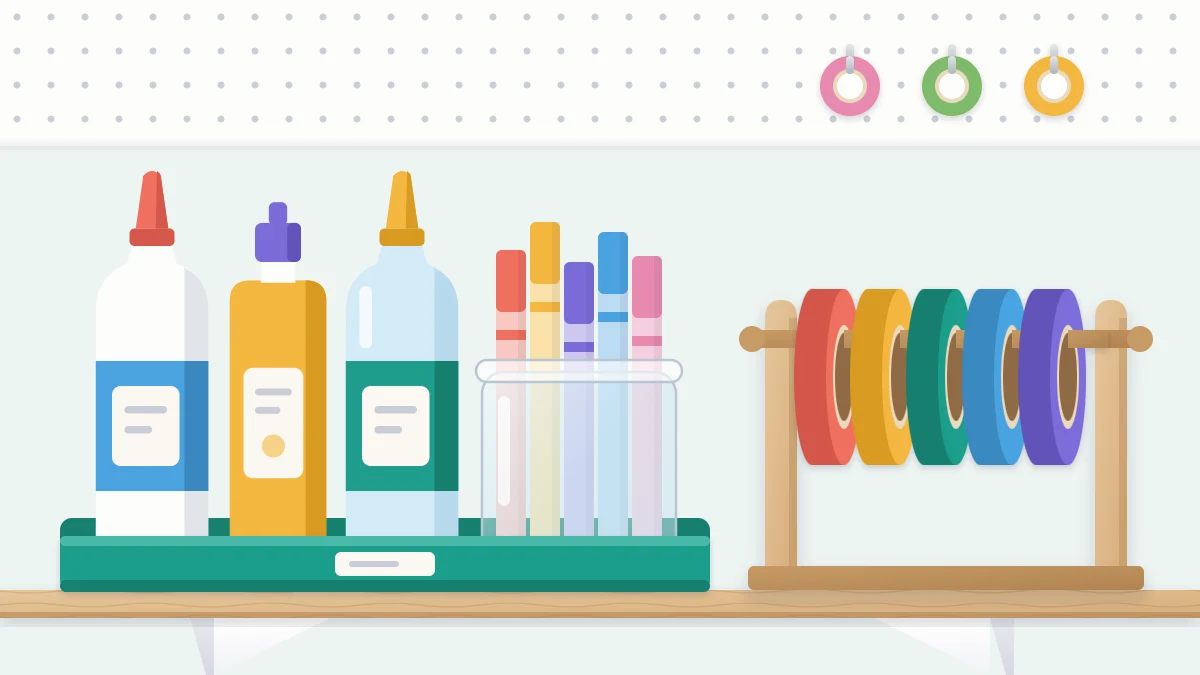
Group adhesives into six kinds and give each a fixed place: bottles upright in a drip tray, glue sticks in a jar, tape on a dowel, the cooled glue gun in its own bin, and strong products stored as their labels direct.
Adhesives cause two different kinds of trouble. Bottles get put away with glue in the nozzle and a loose cap, and are blocked the next time you pick them up. Tape, meanwhile, wanders: one roll in the kitchen, one under a pile of paper, one in a project bag from last spring.
Both problems are storage problems. Knowing how to store craft glue comes down to a handful of plain habits and one fixed place for everything sticky. For specific products, the instructions on the product’s own label always come first; this guide deals with where things go and how to keep them findable.
Group adhesives by kind
Bring every adhesive in the house to one table and sort it into six groups. Each group is stored a little differently.
- White and tacky glues: squeeze bottles of general craft glue, school glue and fabric glue.
- Glue sticks: twist-up sticks and glue pens.
- Tape rolls: clear tape, masking tape, paper tape and decorative tape.
- Double-sided tape and dots: tape runners, foam squares, adhesive dots and sheets.
- Hot glue: the glue gun, its stand and the spare glue sticks.
- Sprays and strong adhesives: spray adhesive, super glue, epoxy and anything solvent-based.
While everything is out, set aside whatever is clearly finished: bottles that have gone solid, sticks dried to a stub, tape that no longer grips. The guide on decluttering craft supplies explains how to decide on the doubtful ones and where unwanted products should go.
Bottled glues: wipe, cap, stand upright
Three habits take care of most blocked nozzles.
- Wipe the nozzle with a damp cloth or paper towel before the glue on it sets.
- Close the cap firmly. Twist caps go down until they stop; push caps go on until they click.
- Stand the bottle upright in a tray that catches drips.
The tray matters as much as the habits. A shallow plastic tray, a baking pan or the lid of a storage box, with sides about 2 in (5 cm) high, keeps bottles from tipping, contains any leak and lets you lift the whole group to the table in one move.
Keep every glue in its original container with the label readable. The label carries the product’s name, what it sticks, and its own storage and safety directions; a plain bottle of unidentified white liquid carries none of that.
Glue sticks, runners and dots
Glue sticks do well standing cap-up in a jar or cup, where you can count them at a glance. Press each cap on until it clicks, and wind the stick down before capping so the cap does not crush the tip.
Tape runners, foam squares and adhesive dots are flat and light, and they collect dust and paper scraps on any exposed sticky edge. Store them in a shallow lidded box or a zip bag, with refills in the same container as the dispenser they fit.
Tape: a dowel or a shallow drawer
Rolls of tape go missing because they have no shape that stacks. Two arrangements solve it.
On a dowel
Thread rolls onto a wooden dowel resting across a box, on two cup hooks under a shelf, or on a paper towel holder. Every roll is visible and you can pull a length without removing the roll. A dowel about 12 in (30 cm) long holds roughly ten to fifteen narrow rolls. Group them by kind, with plain tapes at one end and decorative ones at the other.
In a shallow drawer
Stand rolls on edge in rows, like coins in a tray, so the patterns show from above. Cardboard strips or small boxes used as dividers keep the rows from collapsing when you take one out.
Tape needs something to cut it, and that tool should live beside the rolls, not in them. See how to store scissors, craft knives and rotary cutters so that scissors rest closed and any knife is capped or retracted between uses.
The hot glue gun and its sticks
A glue gun is put away in two stages. First unplug it and leave it on its stand, on a heat-resistant surface, until it has cooled fully. Only then does it go into storage.
- Coil the cord loosely; do not wrap it tightly around the gun.
- Store the gun, its stand and a silicone mat or old ceramic tile together in one box or bin, so the whole kit comes out at once.
- Keep spare glue sticks in a zip bag or a tall jar in the same bin. If you own guns of two sizes, bag the two stick sizes separately and name each bag.
Safety note
Never put a glue gun away warm, and never leave it plugged in unattended. Let it cool completely on its stand first, and store it out of reach of children and pets.
Sprays and strong adhesives: the label decides
Spray adhesive, super glue, epoxy and solvent-based glues are not general craft supplies, and this site does not give storage rules for them. Each product’s label is the authority, together with its safety data sheet. Read both and store the product as they direct.
What you can do as an organizer is make those directions easy to follow:
- Keep these products in their original containers, labels intact and facing out.
- Give them their own container, separate from the everyday glue tray, so they are never picked up by habit.
- Store that container out of reach of children and pets, on a high shelf or in a lockable box or cabinet.
- When one is empty or no longer wanted, follow the label and your local waste rules for disposal.
Where the adhesive station goes
Everyday adhesives belong within reach of the surface where you assemble things: the glue tray, the jar of sticks and the tape dowel together on one shelf or cart tier. As general habits, choose a spot that is:
- Away from heat, including radiators, heaters and lamps.
- Out of direct sun, so not a windowsill.
- Not somewhere that may freeze, such as an unheated garage, shed or porch.
- Out of reach of children and pets.
Paint, sealers and mediums are often used at the same table and follow similar habits; the guide to organizing paint bottles, tubes and jars covers them.
A two-minute check each month
Lift the tray out and look at each bottle. Wipe any nozzle you missed, press down every cap, and move anything that has thickened or dried into the discard pile. Then write down what is running low before the next project needs it.
Frequently asked questions
Why do my glue bottles keep clogging?
Usually because glue is left on the nozzle and the cap is not fully closed, so the glue at the tip sets. Wipe the nozzle with a damp cloth after each use, close the cap until it stops or clicks, and stand the bottle upright in a tray. Check the label for any product-specific advice.
What is the best way to store rolls of tape?
Thread them onto a dowel so each roll is visible and can be pulled without being removed, or stand them on edge in a shallow drawer with dividers. Group rolls by kind, with plain tapes together and decorative ones sorted by color, and keep closed scissors beside them.
Where should I keep spray adhesive and super glue?
Follow the storage directions on each product label and its safety data sheet, since those are specific to the product. Keep them in their original containers, separate from everyday glues, and out of reach of children and pets, for example on a high shelf or in a lockable box.