How to Store Scissors, Craft Knives and Rotary Cutters Safely
Get sharp tools out of the loose drawer: scissors closed in a holder or on a hook, craft knives capped, rotary cutters with the guard shut, and used blades sealed in a labeled container until disposal.
A drawer of loose sharp tools is hard on everything in it. Edges knock against each other and dull, points snag whatever is stored alongside, and the next hand that reaches in finds a blade before it finds a handle.
Knowing how to store scissors, craft knives and rotary cutters comes down to a short set of habits: every edge closed, capped, retracted or guarded, every tool in a place of its own, and used blades contained until they leave the house.
Three rules that apply to every sharp tool
- Cover the edge before the tool leaves your hand. Scissors closed, knife capped or retracted, cutter guard shut. Do it when you put the tool down mid-project, not only at the end of the day.
- Give it a dedicated home. A sharp tool is never stored loose in a bin, bag or drawer of general supplies, where it is found by touch.
- Store it handle-first. Arrange each home so that your hand meets the handle and the point faces down or away.
Scissors: closed, points down or hanging
Close scissors fully before storing them, and if a pair came with a sheath or tip cover, use it. Then choose one of three homes.
- A weighted holder. A heavy jar, a ceramic pot or a block with slots holds scissors upright, points down and handles up. It must be heavy and wide enough not to tip when a pair is pulled out, and deep enough to cover the blades.
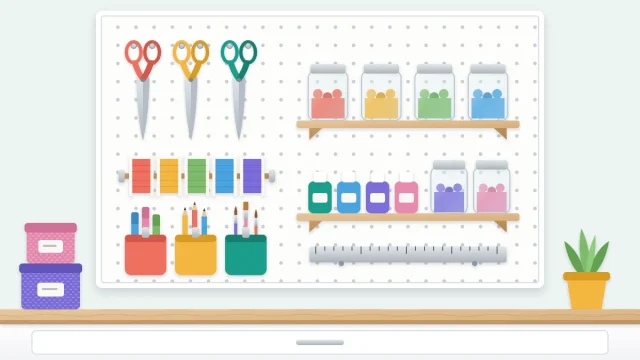
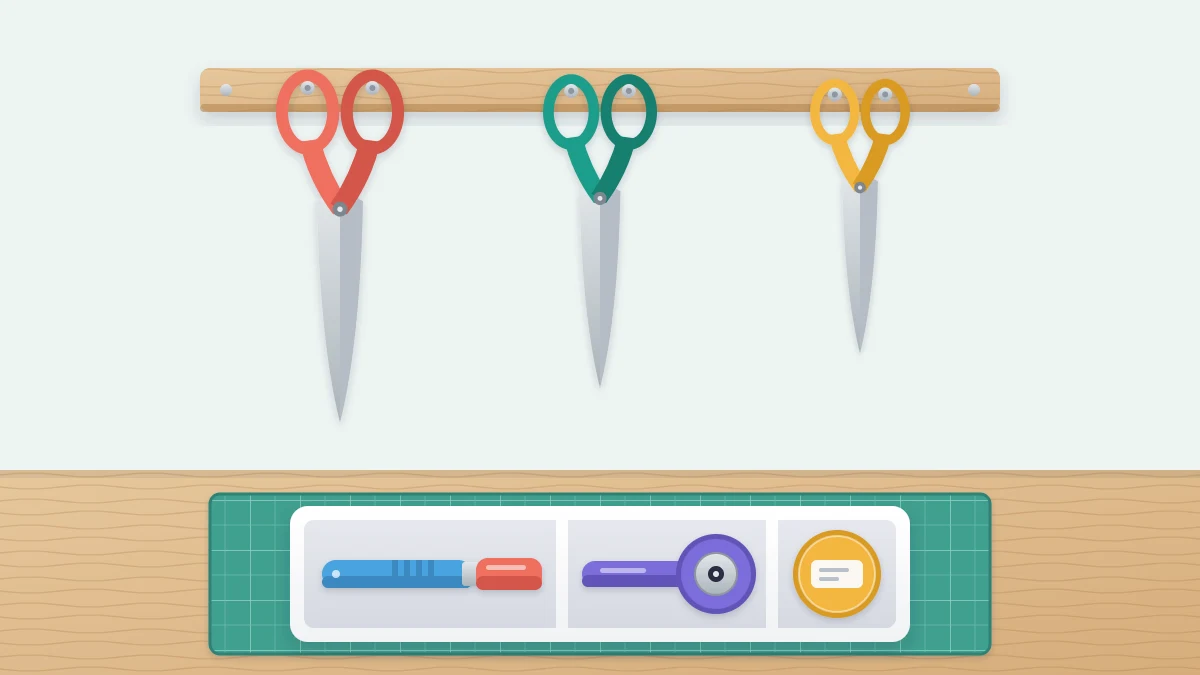
- A hook. Hang closed scissors by one handle loop on a wall hook or pegboard hook, points down, one pair per hook.
- A magnetic strip. Closed scissors hang flat against a strip made for tools. Check that each pair holds firmly when the strip is bumped, and place the strip over a counter or the back of the desk, never above a seat or a walkway.
For help placing hooks among your other tools, see the guide to planning a pegboard wall.
Safety note
Mount any hook rail, magnetic strip or pegboard by following the manufacturer’s instructions. Fix it into wall studs or use anchors suited to your wall type, and stay within the stated weight limit.
Keep fabric shears apart from paper scissors
Fabric shears stay sharpest when they cut only fabric, so they should not share a home with the pair everyone grabs for paper and tape. Store them in the sewing zone, in their sheath, on their own hook or in a drawer slot, and mark the handle with a ribbon or a band of colored tape. Embroidery scissors and thread snips go in a small case or a tip cover, because their fine points bend easily and pierce bags.
Craft knives: capped or retracted, in a tray or stand
A craft knife is stored with its cap on or its blade fully retracted, every time. If the cap has gone missing, get a replacement cap that fits before the knife returns to regular use; tape is not a substitute, because it slips.
Give knives a home where they cannot roll or be buried:
- A shallow tray or drawer divider channel, holding knives only, with all handles pointing the same way.
- A stand or block that holds each capped knife upright in its own hole.
- A lidded pencil box on a high shelf, if the knife is used only occasionally.
Even capped, a knife does not belong in a pen cup. It looks too much like a pen, and someone will pick it up by the wrong end.
Rotary cutters: guard closed every time
A rotary cutter’s edge is exposed all the way around, so its guard matters more than on any other tool. Close the guard or retract the blade each time you set the cutter down, even between two cuts, and engage the lock if it has one.
Store the cutter lying flat in a tray or drawer slot of its own, or hanging by its handle on a hook, guard closed. Do not leave it on the cutting mat under fabric or pattern paper, where it disappears from view.
Spare blades and used blades
Keep the two apart, in containers that cannot be confused.
- Spare blades stay in their original dispenser or case until the moment they are fitted. Store the dispenser in a closed box beside the tool it belongs to.
- Used blades go straight into a small, rigid container with a secure lid, such as a tin or a sturdy tub with a slot cut in the top. Label it as used blades and keep it out of reach, away from the spares.
When the container is nearly full, seal the lid shut and dispose of it according to your local rules. Check your waste service’s guidance, because areas differ. Never drop a bare blade into a wastebasket or a recycling bin.
Needles, pins and awls: closed cases
- Hand needles go in a needle book or a closed case, sorted by type.
- Pins go in a lidded box or a magnetic dish with a cover. An open pincushion is fine while you work, but put it away in a drawer or box afterward.
- Awls and piercing tools are stored with a tip cover or a cork pushed onto the point, lying in a tray slot.
- Bent, blunt or broken needles and pins go into the same sealed container as used blades.
Homes with children or pets
Where children or pets are around, a tidy tray on the desk is not enough. Store all sharp tools, spare blades and the used-blade container out of their reach: on a high shelf, in a cupboard above counter height or in a lockable box. Wall hooks and magnetic strips should sit well above a child’s reach, and not above furniture that could be climbed.
Put sharp tools away before you leave the room, not at the end of the day. In a room used by several people, they belong in the adults-only storage described in the guide to organizing a shared craft space. No container makes a blade harmless, so supervision still matters.
Protect the edges while they are stored
- Never let metal rest against metal. Separate slots, sheaths and caps keep edges from nicking each other.
- Wipe tape residue and lint from scissors with a dry cloth, working from the back of the blade outward, before you close them.
- Store sharp tools dry, away from sinks, water jars and damp windowsills.
- Return each tool to the same spot every time, as part of the wider system for organizing everyday craft tools.
Frequently asked questions
What should I do with used craft knife and rotary cutter blades?
Put each used blade straight into a small rigid container with a secure lid, labeled as used blades and kept out of reach. When it is nearly full, seal it and dispose of it according to your local rules; check with your waste service, because requirements differ between areas.
Is a magnetic strip a good way to store scissors?
It can be, if the strip is made for tools and holds each closed pair firmly when bumped. Mount it as the manufacturer directs, over a counter or the back of a desk rather than above a seat or walkway, and well above the reach of children.
Why should fabric shears be stored separately from other scissors?
Fabric shears keep their edge best when they cut only fabric. Storing them in the sewing zone, in a sheath and on their own hook or slot, makes it less likely that someone will pick them up for paper or tape. A ribbon or colored tape on the handle helps too.