Scrapbook Paper Storage: Vertical, Flat and Portable Options
Five ways to store 12 x 12 paper compared: upright holders, flat trays, hanging folders, shallow drawers and zip portfolios. Plus how to sort sheets, handle pads and stop paper from sagging.
Most paper storage sold for homes and offices is built around letter-size sheets. Scrapbook paper is not letter size, and that single fact explains the bent corners, the stacks on the floor and the pads leaning against a table leg.
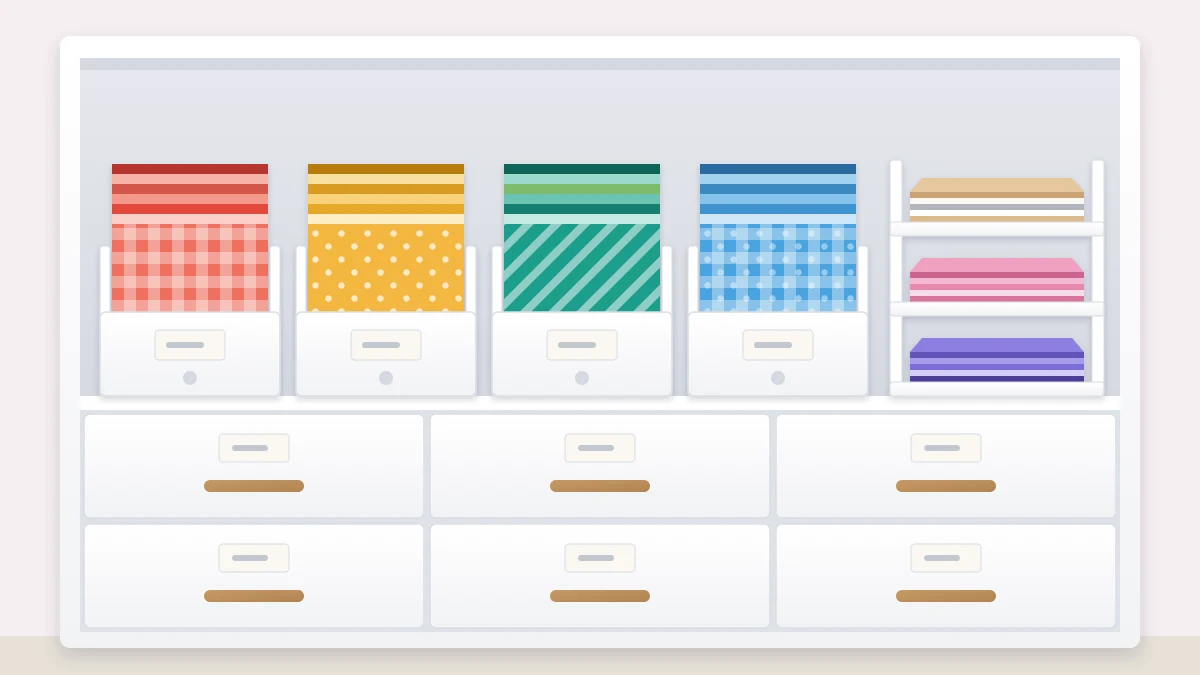
Scrapbook paper storage has two jobs: keep every sheet flat, and let you flip through the sheets without unloading a pile. Five kinds of storage do both, and the right one depends on how much paper you have, how you look for it and whether it ever leaves the house.
Why 12 x 12 paper needs storage sized for it
A sheet of 12 x 12 paper measures 12 in (30.5 cm) on each side, and many pads and sheets carry a narrow extra strip along one edge. Storage therefore needs an inside measurement of at least 12.5 in (32 cm) in both directions, and a little more is better.
Measure the inside of anything before you commit paper to it:
- Letter-size magazine files are too shallow from front to back. Sheets stick out and the exposed edge curls and fades.
- Standard bookshelves are often about 11 in (28 cm) deep, so flat paper overhangs the front edge.
- Cube shelf units commonly have openings of around 13 in (33 cm), which suits both upright holders and flat stacks. Check yours with a tape measure, because sizes vary.
Five storage options compared
| Option | Best for | Watch for |
|---|---|---|
| Vertical holders and magazine-style files made for 12 x 12 | Active collections you browse often; shelves and cubes | Sagging when a holder is under-filled |
| Flat stacking trays | Small collections, specialty sheets, heavy textured paper | Digging through a stack; keep each tray to one category |
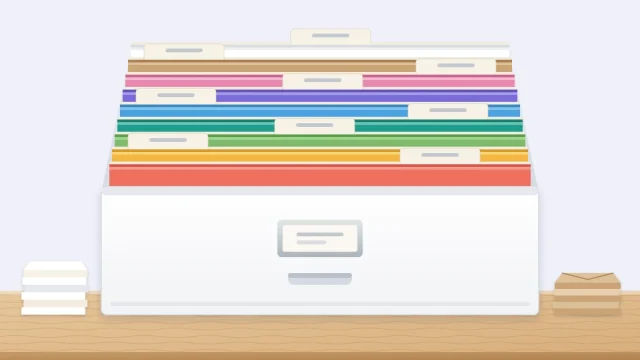
| Hanging file folders in a crate or file box | Large collections sorted into many categories | Needs a crate wide enough for 12 x 12 folders |
| Shallow drawers | Paper you want dust-covered and fully flat | Drawers too deep invite mixed piles |
| Zip portfolios and carry cases | Crops, classes and travel | Limited capacity; pack by project |
Budget versions exist for most of these. A sturdy shipping box of the right size, cut down at an angle on two sides, makes a usable upright holder. Shallow pizza-style boxes, bought new and unused, stack as flat trays. A large zip bag with a sheet of stiff cardboard inside is a workable travel folder.
Vertical or flat: how to choose
Choose vertical storage when you browse by flipping. Sheets standing on edge can be fanned like records in a crate, and each category can be lifted out in its holder and carried to the table.
Choose flat storage when sheets are few, delicate or heavily embellished. Glittered, foiled, flocked and vellum sheets are safer lying flat with a plain sheet between them, because surfaces can scuff when rubbed against a neighbor. Flat also suits paper you keep as complete sets and rarely pick through.
Sort order: color, pattern, theme or collection
How you look for paper should decide how you file it. Think about the question you ask at the start of a page.
- “I need a blue.” Sort by color. Solids and tone-on-tone prints go in spectrum order, neutrals last.
- “I need a stripe.” Sort by pattern type: dots, stripes, florals, plaids, wood grain and text prints.
- “I need something for the beach photos.” Sort by theme: seasons, holidays, travel, baby, school.
- “I want everything from that set.” Keep collections together, each in its own folder or holder section.
A common mix that works is solids by color, patterns by theme, and matched collections kept whole until about half the sheets are used, at which point the remainder is filed by color or theme. Plain solid sheets overlap with cardstock; if you own a lot, the guide to organizing cardstock by color and size covers that sort in detail.
Use a stiff divider between categories so that sections stay distinct. A sheet of chipboard or a cut-down cereal box with a tab at the top is enough.
Paper pads: keep intact or split?
A pad is tidy while it is whole, but its designs are hidden, and pads are often forgotten for that reason.
- Keep it intact if the pad is a coordinated collection you plan to use together, or if you take it to crops. Store pads upright with spines down, grouped by theme.
- Split it if you only ever use single sheets. Tear the sheets out cleanly, file them into your sort order and recycle the backing board, or keep the board as a divider.
If you cannot decide, split pads that are more than half used and leave the newer ones whole.
Prevent sagging, curling and bent corners
Paper stored upright slumps when it has room to lean. A sheet that leans for months takes on a curve that is hard to remove.
- Fill each holder to the point where sheets stand straight but one can still be slid out without scraping. Roughly 1 in (2.5 cm) of free space is plenty.
- Add a stiff backing sheet. In a half-empty holder, put chipboard or thick cardboard cut to 12 x 12 in at the front and back, and use a filler box or a bookend to take up the gap.
- Keep flat stacks short. A stack no taller than about 2 in (5 cm) per tray lets you reach the bottom sheet without bending the ones above.
- Protect the corners. Slide sheets in and out straight, not at an angle, and never file paper so that it sticks out past its holder.
Tip
Offcuts do not belong back in the full-sheet files, where they slip to the bottom and bend. Give them a separate home using a simple paper scrap system.
Where to keep paper in the room
Paper takes up moisture from the air and gives it back, and that movement causes waves and curl. Keep it in a dry room, off the floor, and away from outside walls that feel cold or damp, bathrooms and unheated basements.
Direct sunlight fades printed and dyed paper, and the exposed edge of an upright sheet fades first, leaving a pale stripe. Put holders on a wall the sun does not reach or use a cabinet with doors. If you keep paper for albums meant to last, look for storage boxes and dividers sold as acid-free.
Finally, place paper within a step of the table where you cut it, with the trimmer nearby and your coordinating stickers and die cuts close at hand; those have their own storage options for stickers and embellishments.
Frequently asked questions
Is it better to store scrapbook paper flat or upright?
Upright storage is easier to browse and suits most collections, provided the holders are full enough to keep sheets straight. Flat storage is kinder to glittered, foiled and textured sheets and to small collections. Many people use upright holders for everyday paper and one flat tray for delicate sheets.
Will 12 x 12 paper fit in a cube shelf unit?
Often, yes. Many cube units have openings of around 13 inches, which takes a 12 x 12 holder or a flat stack with a little clearance. Sizes differ between units, so measure the inside width, height and depth of your own cubes before buying holders.
How should I sort patterned scrapbook paper?
File it by the question you ask when starting a page. If you search by occasion, sort patterns by theme such as seasons, holidays and travel. If you search by look, sort by pattern type or dominant color. Keep matched collections together until about half the sheets are gone.