Paper Scrap Storage: A Simple System for Offcuts Worth Keeping
Set a size rule for which paper offcuts are kept, then file them by color, by size or trimmed to standard card dimensions. Includes a desk bin routine and what to do with scraps that fail the rule.

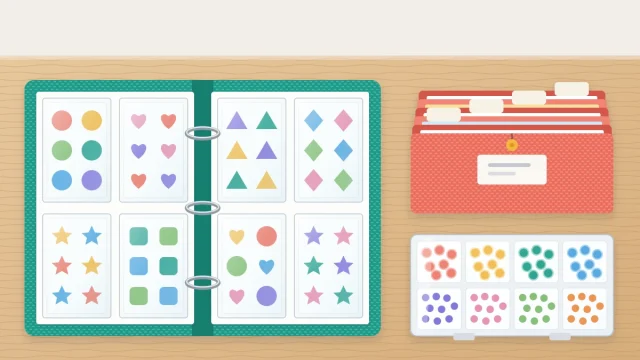
Every card and layout leaves something behind: a strip from the edge of a panel, half a sheet with a window cut out of it, a corner of patterned paper too pretty to bin. Kept without a plan, those offcuts form a drift beside the trimmer that grows faster than you can use it.
A paper scrap storage system needs only three parts: a rule for what is kept, one way of filing what passes, and a schedule for emptying the desk bin. Choose each part once and the pile stops being a decision you face every session.
Start with a keep rule
A keep rule is a size limit you apply without thinking. It saves you from judging each sliver on its charm. Pick one line and write it on a card taped inside the scrap container.
- A simple rule: nothing narrower than 1 in (2.5 cm) and nothing shorter than 3 in (7.5 cm).
- A stricter rule for small spaces: keep only pieces of a quarter letter sheet or more, about 4.25 x 5.5 in (10.8 x 14 cm), which is one standard card front.
- An exception for specialty paper: glitter, foil, mirror and vellum offcuts may be kept down to about 1 in square, because a small piece is enough for an accent. They get one envelope, and the envelope is the limit.
Shape matters as well as size. A piece with a die-cut hole in the middle is judged by the largest clean rectangle left in it. Cut that rectangle out, keep it if it passes and let the rest go.
System one: by color
File scraps into color families and ignore their shape. This is the fastest system to maintain and the best fit if you choose paper by shade.
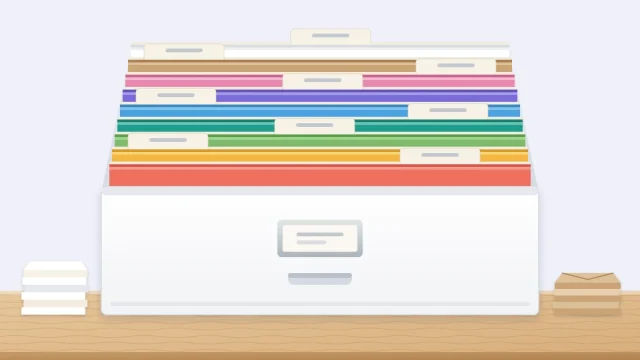
- An accordion file with about a dozen pockets holds a modest scrap collection: one pocket per color family, plus neutrals, whites and patterned paper. Use a file at least letter size so larger pieces lie flat.
- Hanging folders in a file box suit a larger collection and let you lift one color out and take it to the table.
- Large clear envelopes or zip bags standing in a shoebox are the no-cost version.
Match the pocket order to the order of your full sheets, so scraps and sheets of one color sit in the same position. The sequence used for organizing cardstock by color works unchanged.
System two: by size
File scraps by how big they are and let the colors mix. This suits you if you reach for scraps when you need a certain dimension, such as a strip for a border or a piece big enough for a die.
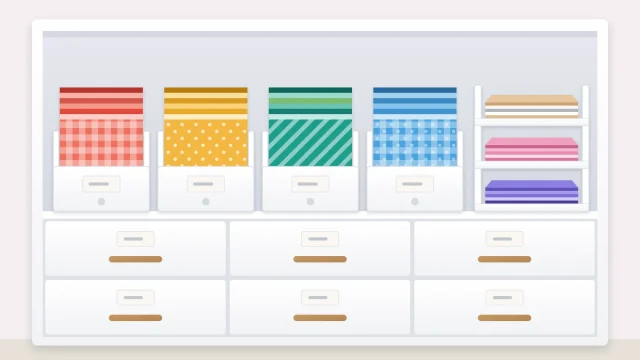
Use three stacked letter trays or three shallow boxes:
- Top: strips, meaning anything long and under about 2 in (5 cm) wide.
- Middle: small pieces up to a quarter sheet.
- Bottom: large pieces, from a quarter sheet up to almost a full sheet.
Keep each tray shallow. When a tray is more than about 1 in deep in paper, the lower pieces stop being seen and the tray needs thinning.
System three: trimmed to standard sizes
Here scraps are cut down to a few set dimensions before they are stored, so they come out of the box ready to use. It takes the most effort up front and gives the neatest result. It suits card makers who work in one card size.
For standard US cards, three or four sizes cover most needs:
- Card front panels, 4.25 x 5.5 in.
- Mat layers a little smaller, about 4 x 5.25 in (10.2 x 13.3 cm).
- Strips 1 in wide and 5.5 in long, for borders and sentiment labels.
- Squares of about 3 in, for die cutting and punching.
Store each size standing on edge in its own section of a small box, like a card file, with a divider between sizes. Anything that will not yield one of your sizes fails the keep rule by definition.
Tip
Do not combine systems. If some scraps are filed by color and others by size, every offcut has two possible homes and you will have to search both.
A desk bin, emptied on a schedule
Filing each offcut the moment it is made interrupts the work. Instead, keep one small open bin on the desk, about the size of a shoebox lid with sides, and drop every offcut into it during a session.
The bin works only if it is emptied on a fixed trigger. Choose one:
- At the end of every session, as part of clearing the table.
- Once a week, on the same day.
- Whenever the paper reaches the rim, with no exceptions.
Emptying takes roughly five minutes. Hold each piece against the keep rule, file the ones that pass and put the rest straight into the recycling. Do not let the desk bin become a second storage system; it is a waiting room.
Use scraps first
Stored scraps are worth the space only if they are used before full sheets. Two placement choices make that happen without willpower.
- Put scraps closer than sheets. The scrap file should be within arm’s reach of your seat, and the full sheets one step further away.
- Check scraps before cutting. For any piece smaller than half a sheet, look in the matching scrap pocket or tray first. This is easiest when scraps mirror the order of your main paper, as described for scrapbook paper storage.
Set a limit and release the overflow
Give scraps a fixed container and treat it as full when it closes easily. A bulging accordion file bends everything inside it. When a pocket or tray is full, thin it before adding more: remove the smallest and most creased pieces first, then the colors and patterns you have skipped over repeatedly.
What leaves can go to several places:
- Recycle plain paper and plain cardstock offcuts with household paper, if your local service accepts them.
- Keep out of the paper recycling anything glittered, foiled, laminated or adhesive-backed unless your local rules say otherwise; check the guidance for your area.
- Pass on clean, colorful pieces to a school, a children’s art group or a fellow card maker. A bag sorted by color is easier to accept than a mixed heap.
If the scrap container fills faster than you can use it, tighten the keep rule by one step rather than adding a second container. The guide to decluttering craft supplies without regret explains why the container, not your resolve, should set the limit.
Frequently asked questions
What size paper scraps are worth keeping?
A common rule is nothing narrower than one inch and nothing shorter than three inches. If space is tight, keep only pieces of a quarter letter sheet or larger. Specialty finishes such as glitter and foil can be kept smaller, because a tiny accent piece is still useful.
Should I sort paper scraps by color or by size?
Sort by color if you pick paper by shade and want the least upkeep. Sort by size if you usually need a particular dimension, such as a border strip or a piece large enough for a die. Card makers who use one card size may prefer trimming scraps to standard panels.
Can paper craft scraps go in the recycling?
Plain paper and plain cardstock offcuts are usually accepted with household paper, though services differ. Glittered, foiled, laminated or adhesive-backed pieces are often not accepted. Check the guidance from your local recycling service and follow it, and pass clean, usable pieces on to a school or art group where you can.