Knitting Needle Storage and Crochet Hook Storage: Cases, Rolls and Jars
Keep pairs together, sizes readable and points covered. A type-by-type guide to storing straight, circular and double-pointed needles and crochet hooks, plus the small notions tin that goes with them.
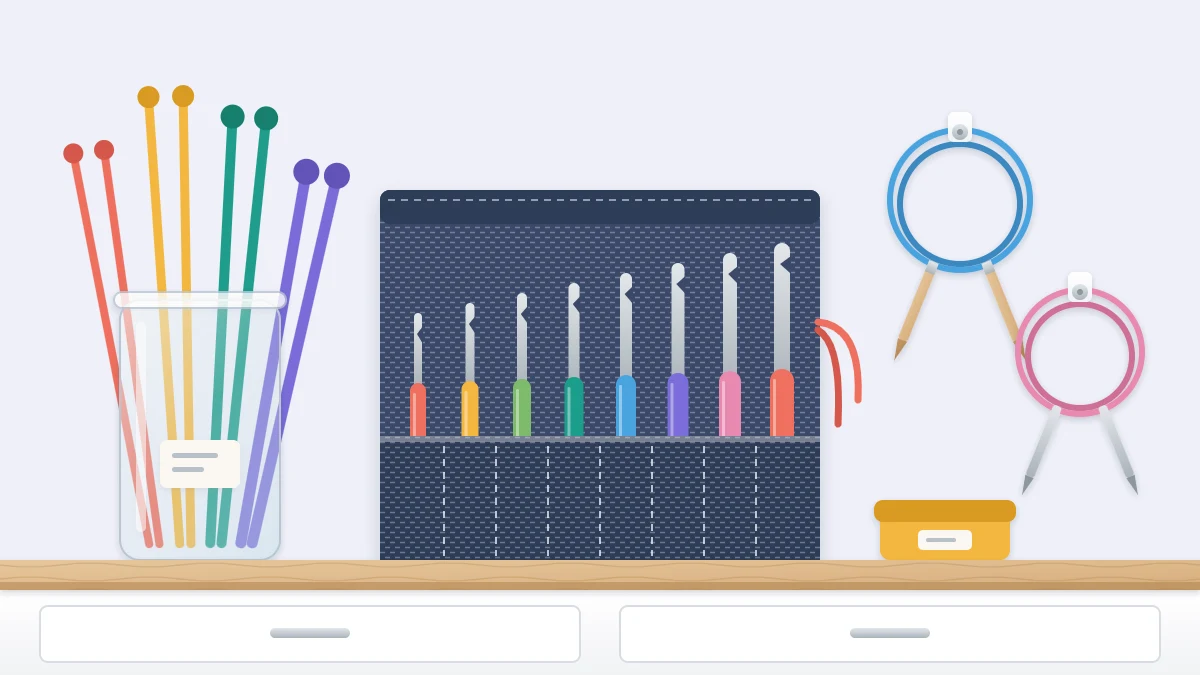
Needles and hooks are the easiest tools in a fiber stash to lose track of. They are thin, they look alike, and a pair separates the moment it goes into a bag with everything else. Good knitting needle storage does three jobs at once: it keeps pairs and sets together, it shows you the size at a glance, and it covers the points so they do not work their way through a bag.
Crochet hook storage follows the same logic in a smaller format. The right container depends on the shape of the tool, so this guide goes type by type.
First, pair up and identify every size
Empty every bag, jar and project pouch onto a table. Lay straight needles in pairs, coil each circular on its own, and gather double-pointed needles into sets of four or five. Then look for a size on each one. Printed sizes wear off, and some needles never had one.
A needle gauge settles it. This is a flat card with a row of sized holes: find the smallest hole the needle passes through cleanly and read off the size. Most gauges show US sizes and millimeters side by side, which also helps with hooks.
Single needles with no partner wait in a “singles” cup for a month, then go. Count what is left: a handful of pairs suits a jar, while a large collection needs pockets.
Straight needles: a tall jar or a fabric roll
Straight needles are commonly 10 in (25 cm) or 14 in (35 cm) long, so they need height and a steady base.
- A jar or vase. Pick one at least half as tall as your longest needle, with a heavy bottom. Stand the needles points down on a disc of felt or cork, and hold each pair together with a small elastic band. If you have to lift out several pairs to reach one, the jar is too full: split it into a small-sizes jar and a large-sizes jar.
- A fabric roll. One narrow pocket per pair, a flap that folds over the tips, and ties to close it. A roll keeps sizes in order and travels well, so it is the better choice for a big collection.
- What you already own. A clean cardboard mailing tube with end caps, or a long zip pencil case for shorter pairs, costs nothing.
Circular needles: three ways to stop the tangle
Circulars cause the most trouble because the cables knot together and the size is printed in tiny type. Give every needle its own slot.
- A hanging organizer. A narrow fabric organizer with one slot per size hooks over a closet rod or a door hook, and the cables hang straight.
- A binder. Zip pocket pages in a ring binder take one size per pocket, smallest at the front. It sits on a shelf like a book.
- Labeled bags. Coil each needle into a loop about the size of your palm, slip it into a small zip bag, and file the bags upright in a shoebox in size order. This is the cheapest option.
Label with two facts: the needle size and the cable length, such as 16 in (40 cm), 24 in (60 cm) or 32 in (80 cm). The same size in a different length is a different tool. Coil loosely every time, since a tight coil sets a kink into the cable.
Interchangeable sets stay in their own case. When a tip leaves for a project, drop a slip of paper in its slot naming the project that has it.
Double-pointed needles: keep the set whole
Double-pointed needles are short, usually 6 to 8 in (15 to 20 cm), and they work only as a complete set. Store each set in its own slim capped tube, a small zip pouch, or a holder that caps both ends at once. A clean travel toothbrush tube is the right length for most sets.
Write the size on the tube, then stand the tubes in a cup or lay them in a shallow drawer in size order. Never bundle two sizes together to save a container. They are very hard to tell apart later without the gauge.
Crochet hooks: one row, in size order
Most hooks are about 6 in long, so they fit containers that needles do not: a zip case with elastic loops, a small roll, or a narrow cup beside your chair. Under a dozen hooks, the cup is enough. Beyond that, a case keeps them from piling up.
Size order matters more than the container. Arrange hooks smallest to largest, left to right, and a missing size shows up as a gap. Very fine steel hooks go in their own capped tube, and thick ergonomic handles need wider loops, so check a case against your largest handle before you commit to it.
A small notions tin
The little things that go with needles and hooks deserve one container of their own: a tin or lidded box about the size of your palm. A useful kit holds stitch markers, tapestry needles, a tape measure, a pencil, the needle gauge and a small pair of scissors stored closed with a tip cover.
Keep tapestry needles in a short tube or pushed into a square of felt, never rattling loose in the tin. If you usually have several projects going, give each project bag a few markers of its own. The guide to storing a work in progress covers what else belongs in that bag.
Cover the points and choose a home
Point protectors, the small rubber caps that push onto needle tips, stop tips from poking through a bag and keep stitches on a needle that is in use. Closed cases and rolls with a flap do the same for whole sets. In a home with young children or pets, choose closed cases over open jars and keep them on a high shelf.
Then decide where the collection lives. Beside the yarn is the natural spot, though not buried in it: if you are still choosing between ways to store yarn, leave one cube or drawer free for tools. The needles and hooks you use every week belong within arm’s reach of your seat, the same rule that guides everyday tool organization for any craft.
One habit keeps the system honest. When a project is finished, return its needles to their slot before you start the next one, so an empty pocket always points to a project bag and never to a lost needle.
Frequently asked questions
How do I find the size of a knitting needle with no marking?
Use a needle gauge, a flat card with a row of sized holes. Try the needle in the holes until you find the smallest one it slides through without forcing. That hole gives the size, usually in both US numbers and millimeters. Label the needle's pocket or tube straight away so you only measure once.
What is the best way to store circular knitting needles?
Give each needle its own slot and label it with both the needle size and the cable length. A hanging organizer lets cables hang straight, a binder with zip pockets sits neatly on a shelf, and small zip bags filed upright in a box cost almost nothing. Coil cables loosely so they do not kink.
Should knitting needles be stored points up or points down in a jar?
Points down is the tidier habit, because nothing sharp sticks up toward your hand when you reach in. Put a disc of felt or cork in the bottom of the jar to cushion the tips, and choose a jar with a heavy base that is at least half the height of your longest needles.