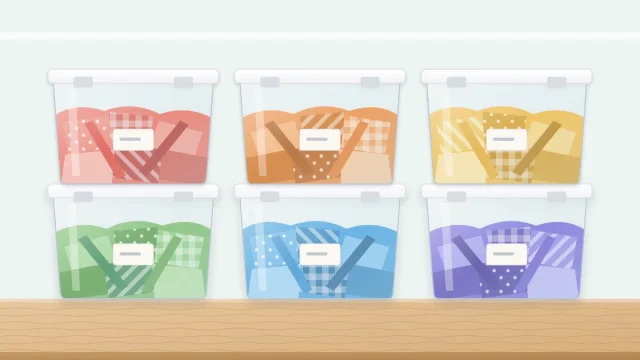
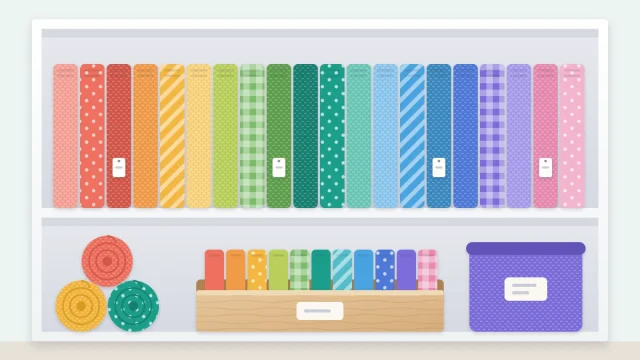
How to Organize Yarn by Weight, Fiber and Color
A step-by-step sorting session for a yarn stash: group by weight first, then fiber or color, keep ball bands attached, bag partial skeins and set up a short inventory you can check before you buy.

At a glance
What you need
- Six to eight boxes or bags as sorting stations
- Zip bags in two sizes
- Sticky notes and a pen
- A kitchen scale
- A notebook, index cards or a spreadsheet
If you have ever come home with a new skein and then found its twin at the bottom of a bin, the problem is not how much yarn you own. The stash has storage but no order. Learning how to organize yarn is mostly a matter of choosing one sort order and applying it to every skein, including the awkward leftovers.
The order that suits most stashes is weight first, then fiber or color inside each weight. What follows is one sorting session from start to finish, the habits that keep ball bands and dye lots with the right yarn, and a plain inventory you can check before you shop.
Why weight comes first
A pattern asks for a thickness before it asks for anything else. When the stash is grouped by weight, you go to one bin and every skein in it is a candidate. A stash sorted only by color puts lace next to bulky, so you handle a dozen skeins to find one that fits.
Use the standard yarn weight categories printed on most ball bands as your group names: lace, fingering, sport, DK, worsted, bulky and super bulky. Only make a group for a weight you actually own.
What to prepare
- A large clear surface, such as a bed or a table with nothing else on it.
- Six to eight boxes, baskets or shopping bags to act as temporary sorting stations.
- Sticky notes and a pen to name each station.
- Zip bags in two sizes: small ones for single partial balls, large ones for groups.
- A kitchen scale, if you have one, for weighing partial skeins.
- A notebook, a stack of index cards or a blank spreadsheet for the inventory.
A medium stash takes roughly two to three hours. If yours fills a closet, work through one bin per session instead.
The sorting session, step by step
- Pull everything out. Empty every bin, basket and tote bag onto the surface. Yarn that belongs to an active project stays in its bag; those are handled by your work-in-progress storage, not the stash.
- Remove what you will not use. Scratchy fibers, colors you no longer like and yarn bought for a plan you have dropped go into a separate bag; see the guide on deciding what to let go of.
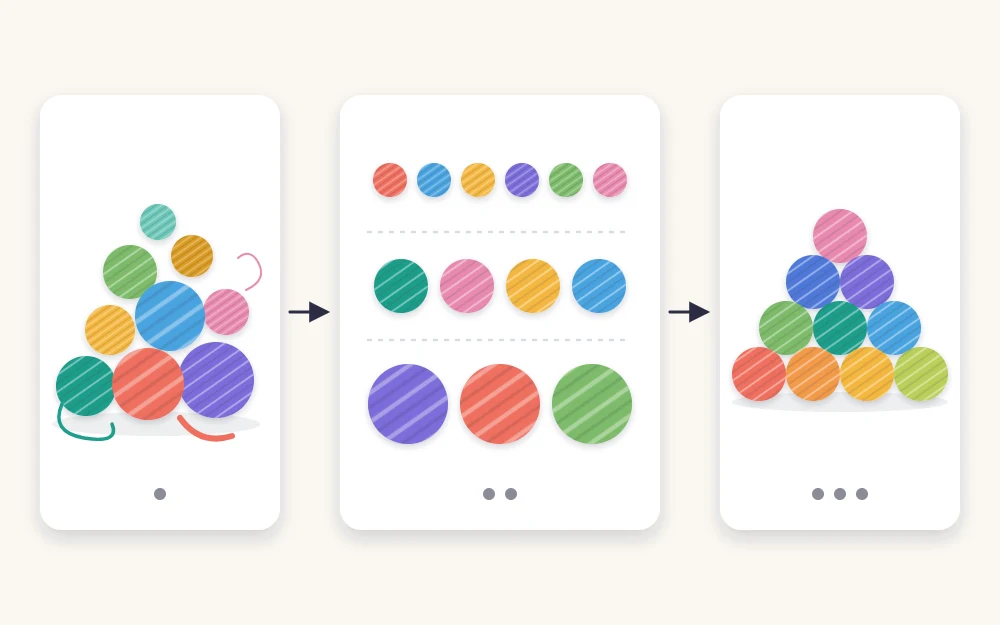
- Sort into weight stations. Read each ball band and drop the skein into the matching station. One decision per skein; no planning yet.
- Identify the mystery yarn. Hold a strand of unlabeled yarn beside labeled skeins and file it with the closest match. For a firmer answer, wrap it around a ruler and compare the wraps in 1 in (2.5 cm) with a labeled yarn.
- Merge thin stations. If a weight has only two or three skeins, combine it with its neighbor: lace with fingering, sport with DK, bulky with super bulky.
- Sub-sort each weight. Divide every station by fiber or by color, using the rule in the next section.
- Bag the partials and scraps, then return each weight to its own bin, shelf or cube.
Fiber or color: choosing the second sort
Pick one second-level sort and use it in every weight group.
- Sort by fiber if your stash mixes wool, cotton, acrylic and blends and you choose yarn by how the finished item will be washed or worn.
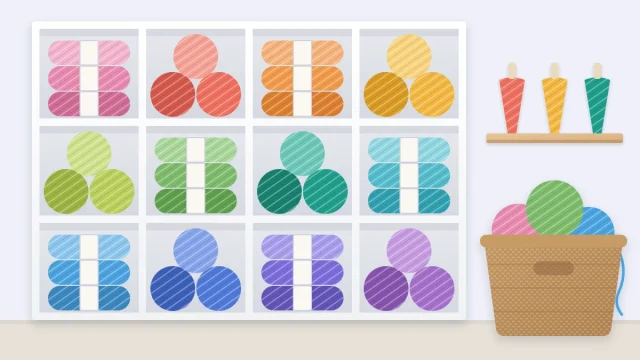
- Sort by color if most of the stash is one fiber, or if you choose projects by palette. Run the colors in spectrum order and put neutrals (white, cream, gray, brown, black) at the end.
Give variegated and multicolor skeins a group of their own at the end of each weight rather than debating which color dominates.
Keep the ball band with the yarn
The ball band carries the weight, fiber, yardage, care symbols and dye lot. Once it is lost, the skein becomes mystery yarn.
- Leave the band on unwound skeins and store them band-out so it can be read without lifting them.
- When you wind a ball or cake, fold the band and tuck it into the center.
- For a partial ball with no band, write what you know on a slip of paper and keep it in the same zip bag.
Sweater quantities need extra care. Keep every skein of one dye lot together in a single large bag, add a note with the skein count, and never split the set between bins. If the yarn is promised to a pattern, write the pattern name on the note.
Partial skeins, leftovers and scrap yarn
Three sizes, three homes:
- Partial skeins (more than about half a ball): weigh them, write the grams on the band, and file them with the full skeins of the same weight.
- Leftovers (small balls still long enough for stripes, edging or a toy): one large zip bag per weight category, kept at the front of that weight’s bin.
- Scrap yarn (lengths under about 1 yd, roughly 1 m): a single jar or small basket for all weights together. When it is full, use it as stuffing or let it go. The jar is the limit.
Tip
Label each bin or bag by weight as you fill it, while you still remember what is inside.
A simple inventory you will actually use
Record five things per yarn: weight, fiber, yardage per skein and number of skeins, color with dye lot, and which bin it lives in.
- Notebook: one page per weight, one line per yarn. Cross out lines as yarn is used.
- Index cards: one card per yarn with a short snip taped on, filed by weight in a small box. The snip shows the true color.
- Spreadsheet: one row per yarn, so you can filter by weight and add up yardage for a pattern.
Update it at two moments only: when yarn comes into the house and when a skein is finished.
Adapting the system to your stash
For a stash that fits in one bin, three groups are plenty: fine (lace to sport), medium (DK and worsted) and thick (bulky and up), each in its own large zip bag, with no second sort.
For a large stash, give each weight its own bin or cube, split the busiest weight into two bins by fiber, and number the bins so the inventory can point to them. The roundup of yarn storage options compares shelves, bins and drawers if you still need to choose the furniture.
Whatever the size, keep yarn clean, dry and away from direct sunlight, and look through stored wool now and then.
Frequently asked questions
Should I organize yarn by color or by weight?
Weight is the more practical first sort, because a pattern specifies thickness before anything else and you can then search a single bin. Color works well as the second sort inside each weight. If your whole stash is one weight, skip straight to color or fiber.
How do I identify yarn that has lost its ball band?
Compare a strand with labeled yarn from your stash and file it with the closest thickness. Wrapping it around a ruler and counting the wraps in one inch gives a firmer comparison. Fiber is harder to confirm, so note it as unknown on a slip of paper kept with the ball.
Do I need a yarn inventory for a small stash?
Not always. If everything fits in one bin and you can see it all at a glance, the bin is the inventory. A written list starts to pay off once yarn is spread over several containers, or when you own sweater quantities whose yardage and dye lot you need to know while shopping.