Shared Craft Space Organization: Storage and Rules for Two or More
Sort a shared craft room by who may use what: personal bins in each person's color, a central spot for shared basics, adults-only storage up high, a project parking shelf and one reset rule.
Most arguments in a shared craft space are not really about mess. They are about ownership: whose scissors those are, who used the last of the white cardstock, and why someone’s half-finished project has been on the table since Tuesday. When nobody knows which things are theirs, which are everyone’s and which are not to be touched, even tidy people collide.
The fix is to sort storage by who may use it before sorting by what it is. Three kinds of storage, a parking shelf and one short rule at the end of each session cover nearly every conflict, whether you share with a partner, children or a group of friends.
Three kinds of storage
Every item in the room belongs to exactly one of these groups. If you cannot say which, that item is where the next disagreement will come from.
| Kind | What goes in it | Where it lives | The rule |
|---|---|---|---|
| Personal | Each person’s own tools, stash and favorites | One bin, shelf or drawer per person | Ask before borrowing |
| Shared | Basics everyone uses: paper, tape, glue sticks, markers, rulers | A central shelf or cart | Use freely, return it, note when it runs low |
| Adults-only | Sharp tools, hot tools, strong adhesives, sprays | A high shelf or a lockable box | Used with an adult, put back by an adult |
Personal storage: one territory each
Give each person a defined territory of the same kind: one shelf, one row of cubes, or one large bin. The size can differ with the size of the stash, but the boundary must be obvious. What is inside is that person’s business, including how tidy it is, as long as the lid closes or nothing spills past the shelf edge.
That last condition matters. The container is the limit. When someone’s territory is full, they decide what leaves, and it does not spread onto the shared shelf.
For young children, choose an open bin at floor or low-shelf height that they can reach and put away by themselves. A lid they cannot manage means supplies left on the table.
Color coding per person
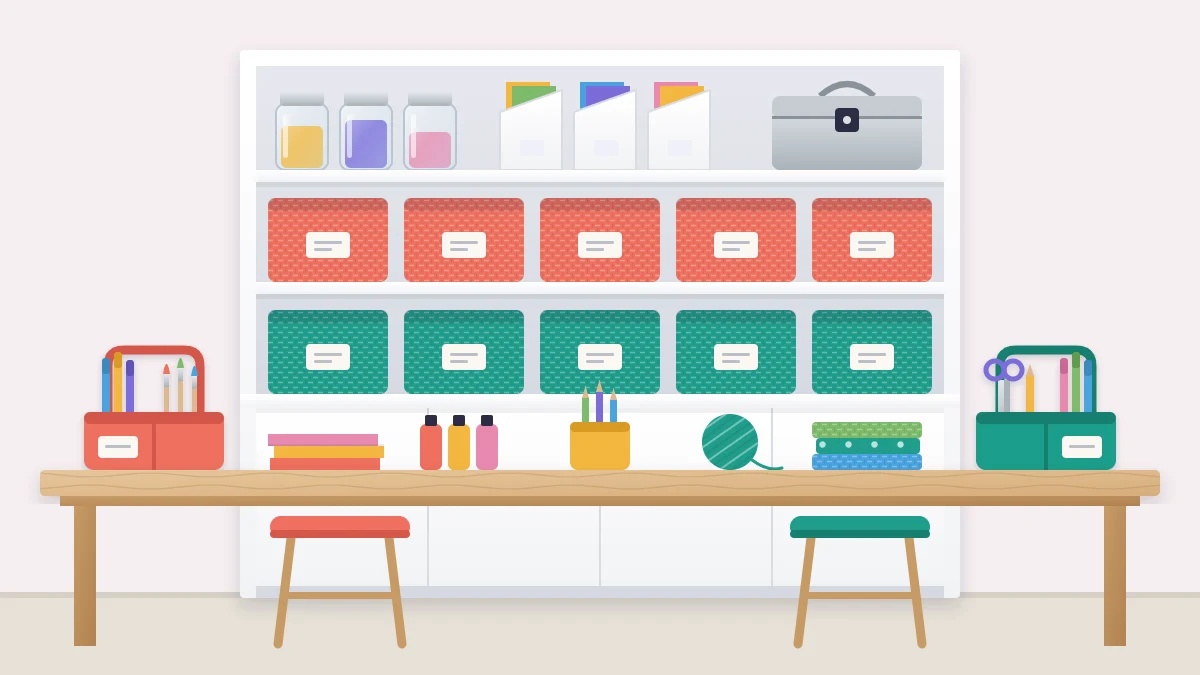
Assign each person a color and use it everywhere: bins, a desktop caddy, a strip of colored tape around tool handles, a dot sticker on the lid of anything personal that travels to the table. Color works for children who cannot read labels yet and for adults glancing across a room.
Keep one color, usually white or a neutral, for shared supplies. Then the system reads itself: your color is yours, someone else’s color means ask, neutral means help yourself. Mark the adults-only box in a color nobody else has.
Shared supplies and the low-stock list
Shared basics live in one central spot that everyone can reach from the table without crossing behind someone else’s chair. A rolling cart is well suited to this, because it can move to whichever end of the table is in use. The guide to setting up a craft cart has a tier-by-tier plan for a shared-supplies cart.
Two habits stop shared supplies from becoming a source of friction:
- A low-stock list. Clip a notepad and pencil to the cart or tape a sheet inside a cabinet door. Whoever opens the last pack or sees a supply getting low writes it down. One person checks the list before shopping. A shared phone note works equally well for adults.
- Duplicates of the cheap basics. If two people reach for the same scissors or glue stick every session, a second one costs less than the argument. Keep one per work area.
Adults-only storage: high or locked
In a space children use, some things are stored out of their reach, on a high shelf or in a lockable box:
- Craft knives, capped or retracted, and rotary cutters with the guard closed.
- Fabric shears and other sharp scissors, stored closed.
- Needles, pins and awls in closed cases.
- The glue gun, left to cool fully on its stand before it is put away, with the cord loosely coiled.
- Spray adhesives, solvents and other strong adhesives, kept in their original containers and stored as each product label directs.
Small parts such as beads and buttons belong here too when very young children or pets are around. For how to hold each sharp tool once it is in the box, see the guide to storing scissors, craft knives and rotary cutters.
Safety note
Agree on who returns adults-only items, and make it the same person who took them out. A sharp or hot tool left on the table at the end of a session is the main risk in a shared room.
A parking shelf for projects in progress
The table is shared, so nothing unfinished stays on it. Each person gets one or two parking spots on a shelf, sized for a tray or a lidded box, and a project that is not being worked on goes there with all its pieces. Trays are best for anything with wet glue or paint, since they can be carried flat.
Limit the spots. When someone’s spots are full, they finish or release a project before starting another. The guide to work-in-progress storage explains what to put in each project container so it can be picked up again without a search.
The reset rule
A shared room needs one rule that everyone, including the youngest, can repeat: when you finish, your part of the table is empty. In practice that means three moves. Personal things go back to your color. Shared things go back to the central spot. The project goes to its parking spot.
Set a timer for about five minutes before the end of a group session so the reset is part of the session, not a chore after it. When the last person leaves, the table should be ready for the first person tomorrow. A fuller version, with weekly and seasonal checks, is in the guide to keeping a craft room organized.
When the shared space is the dining or living room
A craft corner inside a family room has one extra requirement: it must disappear. Use a cabinet with doors, a lidded bench or a cart that rolls into a closet, and give each person a handled caddy or lidded bin in their color that carries to the table and back in one trip. Protect the table with a wipeable mat that stores flat behind the cabinet. If setup and cleanup each take a few minutes, the table gets used for crafts and still gets used for dinner.
Frequently asked questions
How do two people share one craft room?
Give each person a clearly bounded territory, such as a shelf or a row of bins in their own color, and keep shared basics in one central place. Agree that unfinished projects leave the table for a parking shelf, and that each person clears their own area at the end of a session.
How do I organize craft supplies that kids and adults both use?
Put everyday basics such as paper, markers and glue sticks in open bins at a height children can reach and return on their own. Keep sharp tools, hot tools and strong adhesives on a high shelf or in a lockable box, and bring them out only when an adult is working alongside.
What do we do when shared supplies keep running out?
Keep a low-stock list where the supplies live, on a clipped notepad or in a shared phone note. Whoever opens the last pack writes it down, and one named person checks the list before buying. For cheap basics that everyone reaches for, keep a spare so nobody waits.