DIY Ribbon Storage: A Dowel Rack Inside a Box
Build a simple ribbon organizer from a sturdy box and two wooden dowels, with spools in color order and each end clipped to the rim, plus a second small box for loose lengths wound on cards.

At a glance
What you need
- Sturdy shoebox-size box or bin
- Two wooden dowels, about 1/4 in (6 mm) thick
- Awl or sturdy scissors
- Pencil and ruler
- Small clips, one per spool
- Small rubber bands
- Flat cards or wooden clothespins
Ribbon tangles because spools are stored in a heap, where every loose end can wander. Put the same spools on a rod, and each one turns freely, shows its color, and gives up its ribbon without disturbing the others. That is all this DIY ribbon storage project is: a box you already have, two wooden dowels across it, and a clip on each ribbon end.
It needs no sewing and no power tools, and it takes about an hour including sorting. A second, smaller box handles the loose lengths that have no spool.
What to prepare
- A sturdy box or bin about shoebox size, roughly 12 in (30 cm) long. Thick cardboard, a wooden crate or a bin with open slotted sides all work. Thin gift boxes bend under the weight.
- Wooden dowels, about 1/4 in (6 mm) thick. That fits the center hole of most spools. Go up to 3/8 in (10 mm) for a bin wider than about 14 in (35 cm), so the rod does not sag.
- An awl or sturdy scissors, a pencil, a ruler, and a thick pad of scrap cardboard to work on.
- Small clips: mini clothespins or small binder clips, one per spool.
- Four small rubber bands to act as stops on the dowel ends.
- Flat cards or wooden clothespins and a small second box for loose lengths.
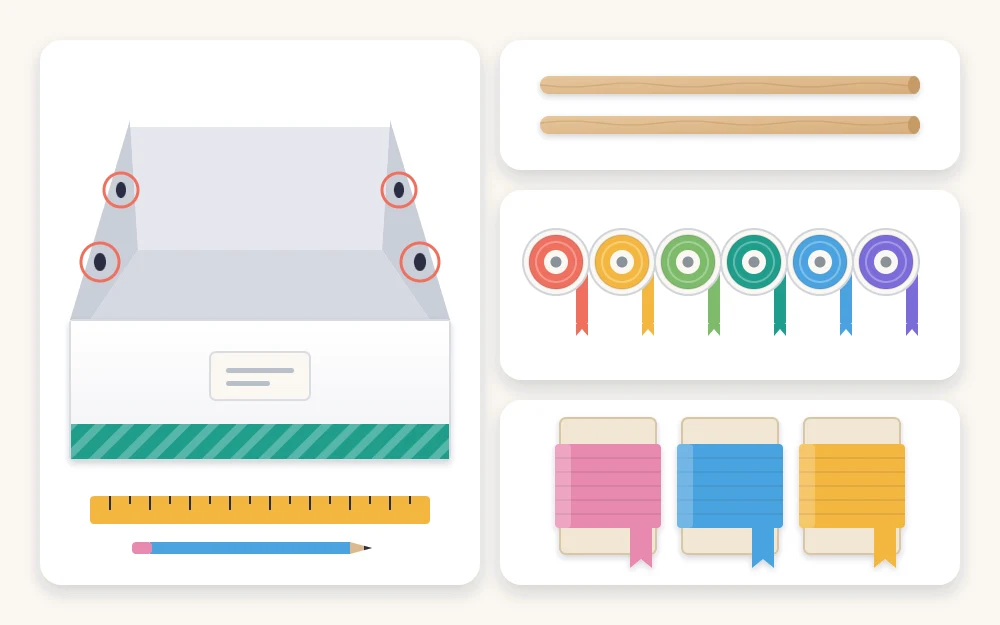
Measure the box and your largest spool
Two measurements decide the whole layout.
Dowel length. Measure the outside of the box from side to side, across the direction the dowels will run, and add about 1 in (2.5 cm). Each dowel then sticks out roughly half an inch at both ends. Many hardware stores will cut it for you if you bring the measurement.
Spool clearance. Measure across your largest spool. The dowel must sit at least half that distance, plus about 1/2 in (1.2 cm), above the bottom of the box and away from the front and back walls, so the spool can turn. Two dowels must be at least one full spool width plus 1/2 in apart.
In practice, a shoebox takes two rows of spools up to about 3 in (7.5 cm) across. If yours are larger, use a single dowel down the middle or a deeper bin.
Holes or notches?
There are two ways to hold the dowels, and the choice depends on how you use ribbon.
- Holes through the sides hold the dowel securely, so the box can be carried. To change a spool you slide the dowel out.
- Notches cut down from the rim, about 1/2 in deep, let the dowel lift straight out. Choose these if you add and remove spools often and the box stays on a shelf.
Either way, mark both sides at the same height and the same distance from the front, measuring from the same corner each time. Dowels that are not level make spools drift to one end.
Build the rack
- Mark the positions in pencil on the outside of both side walls, using the clearances above.
- Make the openings. For holes, lay the box on its side over the pad of scrap cardboard and press the awl through each mark from the outside, then widen the hole by twisting a pencil in it until the dowel passes through snugly. For notches, snip a narrow V or U at each mark with scissors.
- Test the fit. Slide or drop each dowel in with no spools on it. It should sit level and turn without wobbling.
- Thread the spools in color order (see below) with every ribbon unwinding in the same direction, over the top toward the front.
- Seat the dowels and wrap a small rubber band tightly around each protruding end, so the dowel cannot slide out of its holes.
- Bring each ribbon end over the front rim and fasten it there with a small clip. Ribbon from the back row passes over the front row to reach the rim.
Safety note
Punch holes only on a protected surface, pushing the awl away from you with your other hand well clear of the point, never behind the cardboard. If you cut dowels yourself, use a small hand saw with care on a steady surface, with the dowel held firmly. Store the awl with its point covered and the saw with its guard on, out of reach of children.
Put the spools in an order you can read
Sort before you thread, because reordering later means taking everything off the rod. A sequence that works for most collections is color in spectrum order from left to right, then white, cream, black and metallics at the far end. Within one color, place narrow ribbon before wide.
Give seasonal or printed ribbon the back dowel and keep solids on the front one. Leave about 1 in of free rod per row, since a dowel packed end to end stops the spools from turning.
Lace, elastic and other trims on spools can share the rack, though they are easier to find with the rest of your notions. The guide on how to organize sewing supplies shows where they fit.
Wind and file the loose lengths
Ribbon cut from gifts or left over from a project needs its own home, or it ends up stuffed into the rack. Set a keep rule first: lengths shorter than about 12 in are rarely usable and can go.
Wind the rest onto flat cards about 2 by 3 in (5 by 7.5 cm), cut from a cereal box, and hold the end with a paper clip. Or wind each length around a wooden clothespin and pinch the end in its jaws. Stand the cards or pins on edge in a small box, in the same color order as the rack.
Bigger or smaller collections
With fewer than ten spools, one dowel in a small box is enough, and the loose lengths can stand in the space behind it. For a large collection, build two or three identical boxes and split by type, such as solids, prints and seasonal, instead of one long rack that sags. If you are buying bins for this, measure the shelf first, and see the guide to choosing craft storage containers.
To keep the rack working, clip each end back to the rim every time you cut. If you enjoyed building storage from what is already in the house, a DIY craft caddy is a similar quick project for the tools you carry from room to room.
Frequently asked questions
What size dowel fits ribbon spools?
A wooden dowel about a quarter inch thick passes through the center hole of most ribbon spools and is stiff enough for a shoebox-size box. For a wider bin, a slightly thicker dowel sags less. Check your smallest spool hole against the dowel before buying or cutting.
How do I store ribbon that is not on a spool?
Wind each loose length around a small flat card or a wooden clothespin and secure the end with a paper clip or in the clothespin's jaws. Stand the wound pieces on edge in a small box in color order. Very short pieces are seldom worth the space.
Can I use a plastic bin instead of a cardboard box?
Yes, if it has open slotted or lattice sides the dowels can pass through, or a rim the dowels can rest in. Solid plastic is hard to pierce cleanly by hand, so for a solid bin it is simpler to stand a cardboard box with dowels inside it.