Small Craft Room Ideas: Storage That Works in a Tight Space
Practical ways to fit a craft space into a small room or a corner: use wall height, pick furniture that does two jobs, keep the floor clear, and let the space decide how much you store.
A small craft room is not a large one with less in it. It works by different rules: the walls matter more than the floor, every piece of furniture has to justify its footprint, and the size of the stash is set by the room instead of the other way around. Most small craft room ideas that fail are large-room ideas squeezed down.
The ideas here are grouped by the principle behind them, so you can pick the ones that fit a spare bedroom, a landing, or one corner of a room that has another job.
Let the room set the limit
Start with a number, not a shopping list. Measure the wall length you can give to storage and the depth you can spare without blocking the door or the chair. In most small rooms that depth is about 12 to 16 in (30 to 40 cm) for shelving. Anything deeper eats the floor.
That measurement is your capacity. Each craft gets a share of it: two cubes for yarn, one shelf for paper, one drawer for tools. When a share is full, something leaves before something new arrives. This is the one habit that keeps a small space usable, and it is easier to accept when the container makes the decision for you.
Use the wall from desk to ceiling
The wall above your work surface is the largest unused area in almost every small room. Divide it into three bands.
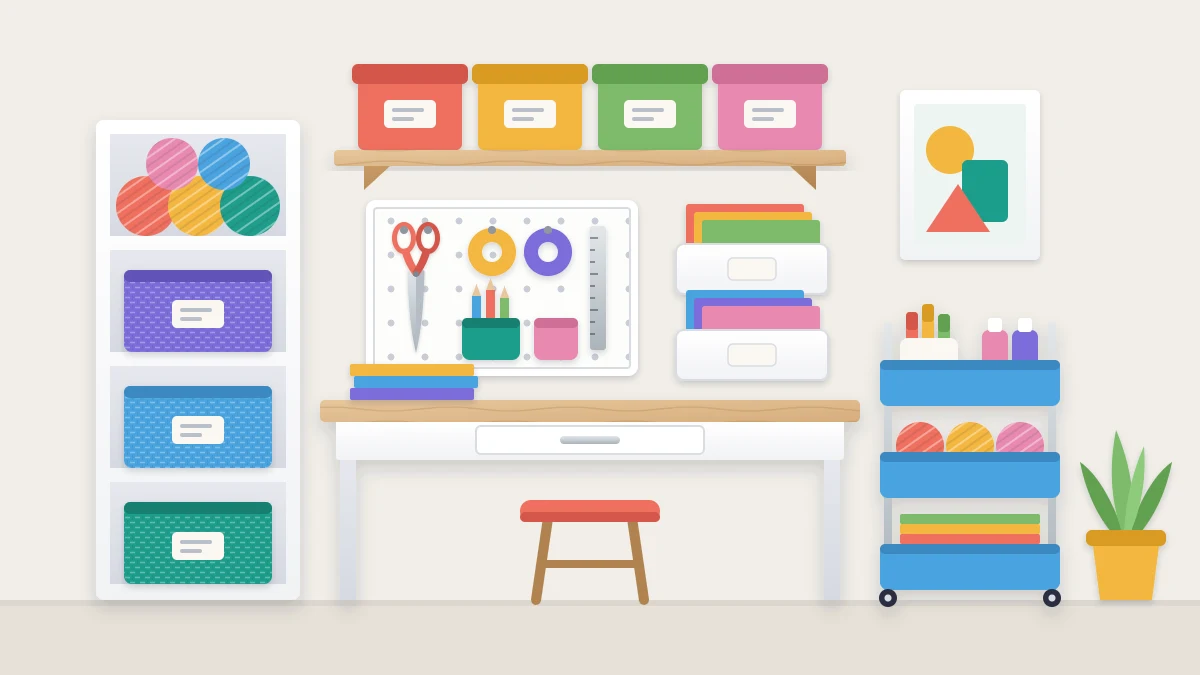
- Desk to eye level: the tools you use every session, hung where you can reach them seated. A panel of hooks and cups does this well, and planning one is covered in these pegboard layout ideas.
- Eye level to arm’s reach: one or two shelves of matching boxes for supplies you use weekly.
- Above arm’s reach: a single shelf over the door or window for light, bulky, seldom-used items such as batting, seasonal supplies and spare packaging. You need roughly 12 in of clear wall above the frame for a row of boxes.
Store paper and flat supplies upright. A vertical file or magazine holder takes a few inches of shelf width where a flat stack would take a whole shelf, and you can pull one sheet without lifting the rest.
Safety note
Any wall shelf, rail or panel should be installed as its manufacturer’s instructions describe, fixed into studs or with anchors suited to your wall type, and loaded within its stated weight limit. Keep heavy items low, and anchor tall shelving units to the wall as their manufacturer directs.
Choose furniture that does two jobs
In a tight room, a piece that only does one thing is a luxury. Look for these instead.
- A drop-leaf or fold-down table. Folded, it leaves the floor open. Open, it gives a full work surface. Check that you have about 30 in (75 cm) of clear floor behind it for a chair when it is in use. A wall-hung fold-down table is mounted following the same rules as a shelf.
- A cabinet or armoire that closes. Shelves inside, hooks or pockets on the doors, and the mess disappears when you shut it. This suits a craft space that shares a room with guests.
- A desk made from storage. A tabletop resting across two low drawer units or cube shelves gives storage under the whole surface. Make sure the top is secure and the knee space in the middle is at least as wide as your chair.
- A storage bench or ottoman. Seating that holds bulky, light supplies such as yarn or fabric.
Keep the floor clear
Floor space is what makes a small room feel workable, so protect it. Nothing lives on the floor except furniture legs and things on wheels.
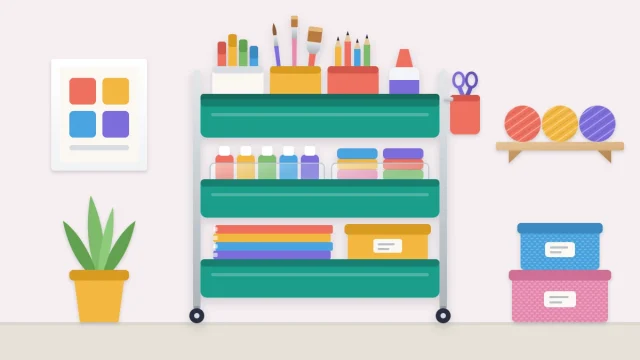
A slim rolling cart is the most useful single item here. It holds the supplies for whatever you are doing now, parks beside your chair while you work, and rolls under the table or into a closet afterward. Setting one up well is its own topic, covered in the guide to organizing a craft cart.
Under the table, add shallow stick-on or clamp-on drawers for pens, small tools and adhesives, keeping craft knives capped or retracted before they go in. Low rolling bins fit beneath a desk for heavier supplies, as long as your knees still have room.
Put doors and dead corners to work
The back of a door holds more than you would expect. An over-door pocket organizer takes small, light things you want to see: tape, glue sticks, stamps, skeins, rolled fat quarters. Check that the door still closes fully with the pockets filled.
A corner too narrow for a shelf unit often takes a tall, slim set of drawers or a corner shelf. The gap between a desk and a wall can hold a cutting mat, a folded table or flat portfolios standing on edge.
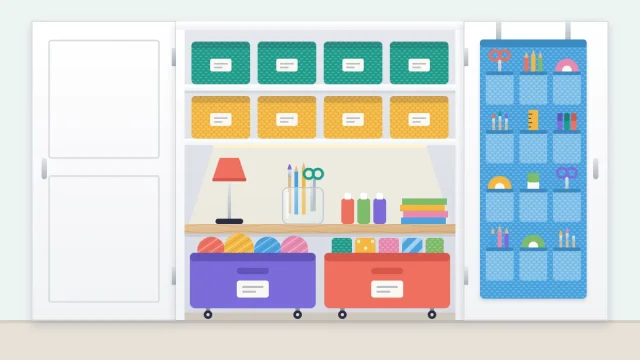
If the room has a closet, treat it as a room of its own. Fitted with shelves and a work shelf at desk height, a reach-in closet can hold an entire craft station behind a door. See the step-by-step guide to craft closet organization for the measurements involved.
Store by how often you use it
With little space, position matters more than quantity. Sort every category into daily, weekly and rare, then place it accordingly: daily within arm’s reach of your seat, weekly one step away, rare up high or in another room entirely. Off-season and bulk supplies do not have to live in the craft room at all. A labeled box under a bed or on a hallway shelf is still organized.
The reasoning behind this reach rule, and how to sketch zones before moving furniture, is explained in the guide to craft room layout.
When the craft room is a corner
For a corner of a bedroom or living room, shrink the same plan. One narrow desk or fold-down surface, one wall panel or shelf above it, one cart beside it. Choose containers in a single color so the corner reads as calm from across the room, and make “clear the surface” the last step of every session. A small space that resets in about five minutes gets used far more than one that takes half an hour to dig out.
Frequently asked questions
How do I set up a craft area with no spare room?
Pick one corner and build upward: a narrow desk or fold-down table, a shelf or tool panel on the wall above it, and a rolling cart that parks beside it. Keep only current supplies there and store the rest in labeled boxes elsewhere in the home, such as under a bed.
What is the best table for a small craft room?
A drop-leaf or fold-down table gives the most surface for the least floor, because it folds away between sessions. If you craft most days, a fixed top resting across two low drawer units may suit you better, since the whole area under it becomes storage.
How much should I store in a small craft room?
Only what its shelves, drawers and cart hold without overflowing. Measure the storage you can fit, give each craft a share of it, and treat a full container as the limit. Seasonal and bulk supplies can live in another room so the craft space holds what you are using now.